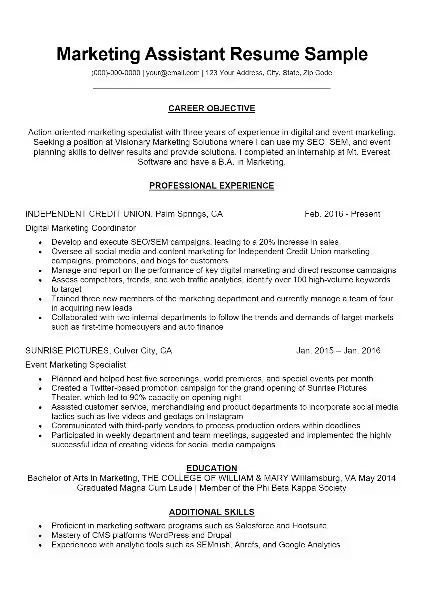
Landing your dream social work job starts with a compelling resume. But showcasing your skills effectively requires more than just listing your experience; it demands a strategic approach that highlights your unique blend of hard and soft skills. This guide will walk you through crafting a social work skills resume that stands out, making you a competitive candidate in a growing field.
Essential Social Work Skills: A Comprehensive Overview
The field of social work demands a diverse skillset. Success hinges on a unique combination of inherent qualities and learned abilities. Let’s explore the key competencies that are crucial for success.
Social workers need to be deeply empathetic, understanding clients from their individual perspectives. This allows for stronger rapport and more effective needs assessments. It’s not just about feeling for your client; it’s about feeling with them, understanding their experiences fully and without judgment. This empathy forms the cornerstone of all successful interventions.
Beyond empathy, exceptional communication is vital. This means effectively conveying information to diverse populations – adapting your style based on age, culture, literacy level, and disability. This also extends to documenting your work precisely and communicating effectively with colleagues and other professionals involved in the client’s care.
Hard Skills: The Technical Expertise
These are the concrete, teachable abilities that form the backbone of social work practice. They demonstrate your practical application of knowledge and are often easily quantified on a resume.
Case Management: Organizing and coordinating client services.
Clinical Assessment: Evaluating client needs and developing intervention plans.
Crisis Intervention: Responding effectively in emergency situations.
Report Writing: Clearly and concisely documenting client progress and interventions.
Trauma-Informed Practice: Understanding and responding to the impact of trauma on clients.
Legal Knowledge: Familiarity with relevant laws and regulations.
Resource Coordination: Connecting clients with appropriate resources.
Counseling Techniques: Applying various therapeutic approaches.
Proficiency in Technology: Using case management software, EHRs, and the Microsoft Office Suite.
Soft Skills: The Interpersonal Edge
While hard skills are valuable, soft skills are equally, if not more, important. They reflect your personality and approach to work, demonstrating your ability to connect with clients and collaborate effectively.
Active Listening: Truly hearing and understanding what clients are saying, both verbally and nonverbally.
Collaboration: Working effectively with colleagues and other professionals.
Communication: Expressing yourself clearly and concisely, both verbally and in writing.
Critical Thinking: Analyzing information objectively and making sound judgments.
Cultural Competence: Understanding and respecting different cultures and perspectives.
Flexibility: Adapting to changing circumstances and client needs.
Problem-Solving: Identifying and resolving challenges effectively.
Resilience: Bouncing back from setbacks and maintaining a positive attitude.
Time Management: Prioritizing tasks and managing your workload effectively.
These skills are vital for establishing trust and rapport with clients, creating a safe and productive therapeutic relationship.
Empathy: Understanding and sharing the feelings of others.
Patience: Remaining calm and understanding, even in challenging situations.
Boundary Setting: Establishing and maintaining healthy professional boundaries.
Trust-Building: Creating a safe and supportive environment for clients.
Community Engagement: Building relationships with community organizations and resources.
Relationship Building: Developing strong, positive working relationships with clients, colleagues, and stakeholders.
Transferable Skills: Adaptability and Versatility
These skills are valuable in any profession and make you a versatile and adaptable candidate. They demonstrate your ability to navigate diverse settings and adapt to evolving challenges.
Advocacy: Championing the rights and needs of clients.
Conflict Management: Resolving disagreements and disputes effectively.
Decision-Making: Making informed and timely decisions.
Documentation: Maintaining accurate and up-to-date records.
Ethical Practice: Adhering to professional ethical standards.
Mediation: Facilitating communication and resolution between conflicting parties.
Public Speaking: Communicating effectively to groups.
Self-Awareness: Understanding your own strengths and weaknesses.
Highlighting Your Social Work Skills on Your Resume
Your resume is your first impression. To make it count, strategically showcase your skills using action verbs and quantifiable achievements. Use keywords relevant to the specific job description. For example, instead of saying “Provided case management,” you could say “Managed a caseload of 25 clients, successfully connecting 80% with needed resources.” This demonstrates your skills and impact.
Remember to tailor your social work skills resume to each job application. Focus on the skills most relevant to the position and organization.
Continuous Professional Development
The social work field is constantly evolving. Continuous learning is essential for staying current with best practices, ethical standards, and emerging challenges. Engage in ongoing professional development through:
Training: Attending workshops and conferences.
Supervision: Receiving guidance from experienced professionals.
Mentorship: Learning from experienced social workers.
Peer Collaboration: Sharing knowledge and experiences with colleagues.
Self-Reflection: Regularly evaluating your practice and identifying areas for improvement.
By mastering these skills and strategically presenting them on your resume, you’ll significantly increase your chances of securing your desired position in this rewarding field.
Social Work Skills Resume FAQ
What are the most important skills to highlight on a social work resume?
A successful social work resume showcases a blend of hard and soft skills. Hard skills demonstrate your technical abilities, such as case management, crisis intervention, report writing, and proficiency with relevant software (e.g., case management software, EHRs). Equally crucial are soft skills like empathy, active listening, communication (verbal and written), cultural competence, critical thinking, and strong organizational and time management skills. Highlighting your proficiency in these areas demonstrates your readiness to handle the multifaceted demands of the profession. Remember to quantify your accomplishments whenever possible.
How can I showcase my empathy and understanding on my resume?
Empathy isn’t directly quantifiable, but you can demonstrate it through accomplishments. For instance, instead of simply stating “Provided support to clients,” write “Successfully de-escalated a crisis situation with a distraught client, resulting in a reduction of anxiety and improved coping mechanisms.” This shows your ability to understand and respond to clients’ emotional needs effectively. Consider using action verbs that highlight your empathetic approach, such as “supported,” “empowered,” “listened attentively to,” or “provided compassionate care to.”
How do I demonstrate strong communication skills on my resume?
Demonstrate strong communication skills by providing concrete examples. Did you present complex information to diverse audiences? Did you successfully mediate conflicts between parties? Did you create clear and concise reports? Quantify your achievements whenever possible. For example, instead of “Communicated effectively with clients,” try “Successfully communicated complex treatment plans to over 30 clients with diverse literacy levels, resulting in improved treatment adherence.”
What organizational skills are most relevant to social work?
Social workers juggle many responsibilities. Highlight your organizational skills by showcasing your ability to manage multiple cases simultaneously, meet deadlines, prioritize tasks effectively, and maintain accurate records. Examples include “Managed a caseload of 25 clients, ensuring timely completion of all required documentation and follow-up appointments” or “Developed and implemented a new filing system, improving efficiency by 15%.”
How can I demonstrate critical thinking and analysis skills?
Showcase critical thinking by describing situations where you analyzed information, identified problems, developed solutions, and evaluated outcomes. For example, “Analyzed client data to identify patterns and trends, leading to the development of a more effective intervention strategy.” or “Identified a gap in existing resources for a specific client population and successfully advocated for the implementation of a new program.”
How do I highlight my cultural competence on my resume?
Showcase your cultural competence by describing experiences where you demonstrated sensitivity to diverse cultural backgrounds and adapted your approach accordingly. This could involve examples of working effectively with clients from different cultural or linguistic backgrounds, demonstrating an understanding of cultural norms and beliefs, or participating in cultural sensitivity training. Quantify your impact whenever possible. For example, “Developed and implemented culturally sensitive interventions for a diverse client population, resulting in a 20% increase in client engagement.”
Beyond the typical skills, what else should I include?
Consider including skills related to advocacy, ethical practice, self-care, resilience, and professional development. Demonstrate your commitment to ongoing learning and professional growth by mentioning relevant workshops, training, or certifications. Remember to show, don’t just tell. Use the STAR method (Situation, Task, Action, Result) to provide specific examples of your accomplishments and quantify your impact whenever possible.
How important is mentioning technology proficiency?
Technology proficiency is becoming increasingly important in social work. Highlight your skills with relevant software (e.g., case management systems, EHRs, telehealth platforms) and any relevant technology used in your previous roles. Mentioning familiarity with Microsoft Office Suite is also beneficial.
What are some action verbs I can use to strengthen my resume?
Strong action verbs help showcase your achievements. Consider using verbs like: facilitated, implemented, managed, collaborated, advocated, resolved, developed, assessed, analyzed, coordinated, mentored, trained, and empowered. Tailor your verbs to the specific accomplishment you are describing.
Finding out where someone works can be a necessary task for various reasons, from professional networking to verifying employment for a loan application. However, it’s crucial to approach this information gathering ethically and legally, avoiding methods that could compromise privacy or be potentially harmful. This guide will outline safe and effective strategies to help you…
Many couples in New Jersey choose to live together without the formality of marriage. Understanding the legal implications of this choice is crucial, especially when the relationship ends. This article explores the legal landscape of long-term cohabitation in New Jersey, addressing common misconceptions and outlining the available legal recourse for separating couples. The Absence of…
Sending gifts from the USA to India for your parents can be a deeply rewarding experience, a way to show your love and appreciation from afar. However, navigating the process can feel overwhelming. What kind of gifts will they truly appreciate? What are the logistical challenges involved in international shipping? This guide aims to simplify…
Choosing cooking oil might seem simple, but the environmental impact of your everyday cooking can be surprisingly significant. The global oil industry, while providing essential nutrients and culinary versatility, often prioritizes profit over planet health. This article explores the environmental footprint of various cooking oils to help you make informed, eco-conscious choices. The Environmental Toll…
Many of us face daily challenges that require careful consideration before making a decision. Whether it’s choosing a career path, selecting a new home, or even deciding what to have for dinner, the process often feels overwhelming. This article explores the concept of a “consider function”—a mental framework—to help you navigate complex decisions more effectively….
Finding the right legal assistance can be challenging, especially when language is a barrier. If you need legal support and prefer to communicate in Spanish, understanding the role of a paralegal español is crucial. This guide will help you navigate the process of seeking a Spanish-speaking paralegal and ensure you find the perfect fit for…