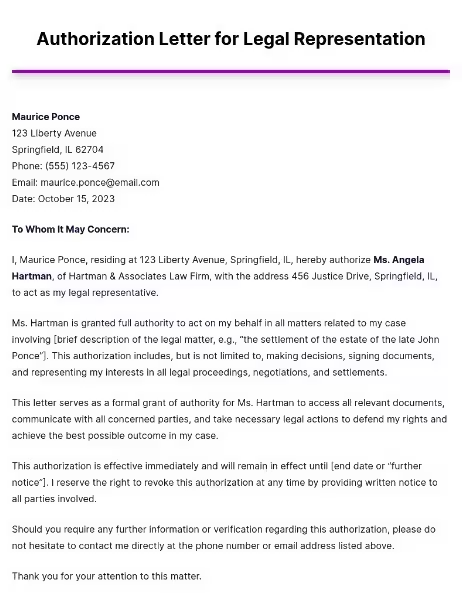
Formal agreements are a cornerstone of business and personal life, governing everything from major commercial deals to simple sales. But what exactly constitutes a formal agreement, and how does it differ from an informal one? This article aims to demystify the concept of formal agreements, providing a clear understanding of their nature and importance.
Historically, a formal agreement was defined by the presence of a seal – a physical symbol, often wax, attesting to the parties’ solemn commitment. Only those explicitly named could claim rights or liabilities under the agreement. This practice, however, is largely obsolete in modern legal systems. Professor Harvey Boller (citation needed) suggests that the vast majority of contracts today are considered informal.
This doesn’t mean seals are entirely irrelevant. Their historical significance sheds light on the evolution of the concept of formality in contracts. The core principle remains: the intention to be bound. A seal, in its time, served as a powerful visible manifestation of that intent.
Formality vs. Enforceability: A Key Distinction
The crucial point to understand is that the formality (or lack thereof) of an agreement doesn’t automatically dictate its legal validity or enforceability. Both formal and informal contracts are legally binding if they contain the essential elements of a valid contract:
Mutual Agreement: A meeting of the minds on the terms of the agreement.
Offer and Acceptance: A clear offer by one party and an unequivocal acceptance by the other.
Consideration: Something of value exchanged between the parties (this could be money, goods, services, or a promise).
Capacity: The parties must be legally competent to enter into a contract (e.g., of legal age, sound mind).
Legality: The subject matter of the contract must be lawful.
These elements, not the presence or absence of a seal, are what determine a contract’s validity.
Modern Interpretation of “Formal Contract”
As outlined by Clarkson, Miller & Cross in Business Law (12th ed.), the term “formal contract” has evolved. It now encompasses contracts that necessitate a particular form or method of creation for enforceability, as mandated by law or statute. This shifts the emphasis from the physical seal to the prescribed format.
A prime example is negotiable instruments, such as checks, drafts, promissory notes, and certificates of deposit. These are considered formal contracts because the Uniform Commercial Code (UCC) dictates specific requirements for their creation and execution. Their enforceability hinges on adherence to this prescribed form, not the presence of a seal.
Therefore, the modern understanding of formal agreements centers on adherence to legal specifications for creation and execution. The label – formal or informal – is secondary to the contract’s adherence to fundamental contract law principles.
Written vs. Oral Agreements
While the use of a seal holds little weight today, the distinction between written and oral agreements still carries significant legal ramifications. Written agreements, even without a seal, are generally preferred for several reasons:
Evidence: A written contract provides clear and irrefutable evidence of the agreement’s terms.
Clarity: A well-drafted written contract minimizes ambiguity and potential disputes.
Enforceability: Courts generally favor written contracts, especially in complex transactions.
Oral agreements, while sometimes legally binding, can be much harder to enforce. Disputes can arise over the terms of the agreement, making it challenging to prove what was agreed upon. This underscores the importance of documenting agreements in writing, especially for significant matters.
Key Differences between Simple and Formal Contracts
The distinction between simple and formal contracts lies primarily in their form and enforceability. Simple contracts, whether oral or written, have straightforward terms. However, their informal nature can hinder enforcement, particularly if oral, due to potential conflicting accounts of the agreement. Proving the agreement’s existence and its specifics becomes crucial. Lack of written evidence can significantly weaken a party’s case.
In contrast, formal contracts are always written and often require witnesses. They contain detailed terms and clauses, providing a clear record. Their detailed nature contributes significantly to their enforceability. Courts generally favor upholding formal contracts, provided they were entered into voluntarily and don’t contain unfair terms. Breach usually results in contract fulfillment or compensation for damages.
The Importance of Legal Counsel
Regardless of whether a contract is simple or formal, seeking legal advice before signing is crucial. A lawyer can ensure the agreement protects your interests and minimizes the risk of disputes or litigation. This is particularly important for complex transactions or when significant financial commitments are involved. The peace of mind provided by a professional review is invaluable.
This comprehensive understanding of formal agreements, from their historical roots to their modern interpretation, highlights the importance of clarity, documentation, and legal counsel in ensuring the validity and enforceability of agreements. A formal agreement, while not defined by a seal, represents a commitment backed by the strength of legal principles and clear documentation.
Frequently Asked Questions about Formal Agreements
What is the difference between a formal and an informal contract?
Historically, a formal contract was distinguished by the presence of a seal (e.g., wax). Today, the distinction lies less in a physical seal and more in the required form or method of creation for enforceability. While informal contracts can be oral or written, formal contracts generally require a specific written format, often dictated by law or statute (such as negotiable instruments). Importantly, the formality (or lack thereof) does not automatically determine a contract’s legality. Both can be legally binding if they contain the essential elements of a valid contract.
What are the essential elements of a valid contract, regardless of formality?
A valid contract, whether formal or informal, requires: mutual agreement (offer and acceptance), consideration (something of value exchanged), capacity (parties legally competent to contract), and legality (the subject matter must be lawful). The intent to create a legally binding agreement is also crucial.
Does a contract need to be in writing to be enforceable?
While some contracts can be legally binding even if oral, many situations necessitate a written contract for enforceability and clarity. This is particularly true for significant transactions or those involving complex terms. Many business contracts, such as NDAs, employment agreements, and license agreements, must be in writing.
What are some examples of formal contracts?
Negotiable instruments like checks, drafts, promissory notes, and certificates of deposit are prime examples of formal contracts. Their enforceability hinges on adhering to the specific requirements outlined in the Uniform Commercial Code. Other contracts might require a specific format or notarization to be considered formal, depending on the jurisdiction and subject matter.
What is the significance of a seal in modern contract law?
The historical significance of a seal as a marker of a formal contract has diminished considerably. The presence or absence of a seal is largely irrelevant in modern contract law. The focus is on whether the contract meets the necessary legal requirements for validity and enforceability.
Why are formal contracts preferred in business?
Formal contracts provide clear, written documentation of the agreement, minimizing the risk of disputes arising from conflicting accounts or vague terms. They offer greater legal protection and are generally easier to enforce in court compared to informal contracts, especially oral ones. This is particularly crucial for complex transactions or partnerships.
What should I do if I have questions about a contract?
It is strongly recommended to seek legal counsel from a qualified attorney before signing any contract, whether formal or informal. An attorney can ensure the agreement protects your interests and is legally sound. This is especially important for complex agreements or high-value transactions.
The term “Obamna amnesty” might initially seem nonsensical, a bizarre blend of a former president’s name and a controversial political topic. However, understanding its origins and evolution reveals a fascinating glimpse into the intersection of internet slang, political rhetoric, and meme culture. This article will explore the history and usage of this unusual phrase, shedding…
The Senior Courts Act 1981 is a cornerstone of English and Welsh law, defining the structure and powers of the nation’s highest courts. While the full text can be complex, understanding its key provisions is crucial for anyone involved in or interested in the legal system. This article offers a clear and accessible overview, breaking…
Navigating the complexities of New York City’s Local Law 31 can be daunting for property owners. This comprehensive guide aims to clarify the requirements, deadlines, and responsibilities associated with this crucial legislation designed to protect tenants from lead-based paint hazards. Lead Paint Testing Under Local Law 31 Local Law 31 mandates comprehensive lead paint testing…
This article aims to explore Malek Management, a professional organization based in Valley Stream, New York, and to shed light on what we can infer about its operations and client offerings, given the limited information available. While specifics regarding their services remain undisclosed, we can examine the company’s stated values and deduce likely aspects of…
Finding love and building meaningful connections can be a challenge anywhere, but especially in a vibrant and diverse city like Los Angeles. For women in Los Angeles, navigating the dating scene might present unique opportunities and challenges. This article explores the landscape of dating and relationships for mujeres en los angeles and offers insights into…
Many professionals dream of climbing the corporate ladder, but understanding how to effectively “move up the organization” requires more than just hard work. It demands a strategic approach that blends skill development, networking, and a keen understanding of organizational dynamics. This article explores practical strategies to help you advance your career within your company. Understanding…